Tracing Seal Provenance in a Mountain Monastery: A Research Stay at Montserrat
By Kepa Martinez Garcia | 17 December 2025
This blog post is about a small collection that of the Monastery of Montserrat in Catalonia, Spain. Only a small portion of the seals in this collection has been published, which made it an ideal starting point for studying original artifacts for my doctoral thesis. Recognising the importance of making these materials more widely known, I decided to collaborate by integrating the Montserrat collection into the KIŠIB project—a major digital humanities initiative that aims to create a comprehensive, openly accessible database of ancient West Asian seals and sealings. By contributing systematically documented data, including 3D scans and detailed metadata, these previously obscure objects become part of a growing corpus available to researchers worldwide.
The Museu de Montserrat and its unexpected Mesopotamian treasures
The Museu de Montserrat, located in the Montserrat Monastery in Catalonia, has evolved over more than a century from the Museo Bíblico inaugurated in 1911. Its founder, Father Bonaventura Ubach i Medir (1879–1960), collected archaeological, ethnological, zoological, and botanical materials from the Holy Lands, Egypt, Syria, and Iraq to illustrate the Bible in his homeland.
In 1963, the museum was formally established with its Near Eastern archaeological collection and Renaissance and Baroque paintings from the monastery. Subsequent expansions included 19th- and 20th-century paintings, new exhibition spaces in 2004, and the opening of the "Montserrat s. XIV" room in 2023 showcasing the oldest preserved constructions of the monastery. Recognized as a museum of national interest, it continues to grow through donations and remains one of Catalonia’s most visited and prominent cultural institutions.
Few people realise that the museum houses the only collection of Ancient Near Eastern objects in Spain, including a set of 75 cylinder seals collected by Father Bonaventura (Márquez Rowe, 2015).
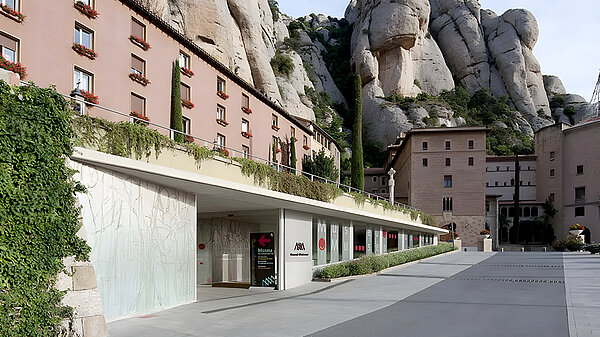
Although small, the collection is remarkably coherent - all the seals were acquired during a single journey, though not from a single dealer, and entered the museum together. This unusual circumstance gives them a unity rarely encountered in other European collections, where objects often arrived through dispersed acquisitions, auctions, or donations, and sometimes —at best—directly from archaeological excavations.
How everything started
My interest in the Montserrat collection emerged naturally from my doctoral dissertation project, which originally explored urban identities and inter-city relations from Late Uruk to Early Sargonic era in southern Mesopotamia by means of sphragistic analysis (a combination of morphological, contextual and iconographical analysis on seals and sealings).
A recurrent difficulty in this field is that many seals preserved in museums lack findspots: they are unprovenanced, detached from their original archaeological contexts.
It was no different with the Montserrat corpus. Nevertheless, containing cylinder seals from nearly all periods, it was acquired as a coherent lot by one collector in one place and time. Could this collection offer clues about their geographical origin? Could stylistic, iconographic, or material features indicate provenance from Ur, Uruk, Girsu, Nippur, or other urban settlements? I had this and other questions in mind when I learned about the collection the first time.
The Montserrat collection was an ideal test case, because of its manageable size, and I was also particularly drawn by the fact that this collection is kept in Catalonia—relatively close to my hometown compared to other European collections—which offered a unique opportunity to study a diverse range of objects in one place.
I made a couple of visits to the museum and spoke with its director, brother Xavier Caballé, prior to the research stay on the seals, and from the very first moment I could see his interest and willingness to facilitate access to the materials. I also contacted the museum’s curator, Montse Marín, a great expert on the collection who had previously collaborated with other researchers. With their full support, and a letter of recommendation from my supervisor in the University of the Basque Country, I travelled to Montserrat in November 2023 for a focused week of study.
Inside the vaults of the abbey
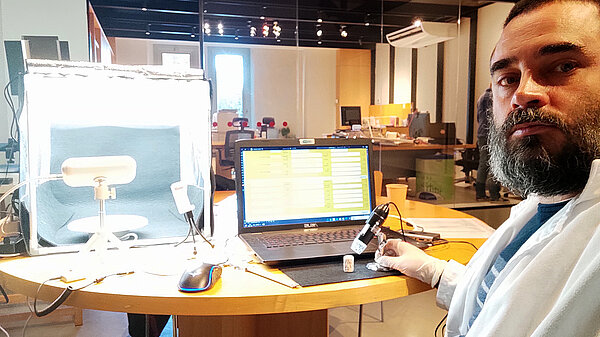
During my stay, I documented, photographed, and analysed each one of the Bronze Age seals in the collection in detail.
Because the collection is much smaller than those of major European museums, it allowed for a level of attention rarely possible with larger corpora. From my experience studying artifacts at the Musée du Louvre in Paris and the Vorderasiatisches Museum in Berlin, access to objects, available time, and the use of certain equipment are often limited due to organizational or conservation constraints. At Montserrat, however, all of these factors were much more manageable, allowing for a more thorough and hands-on study.
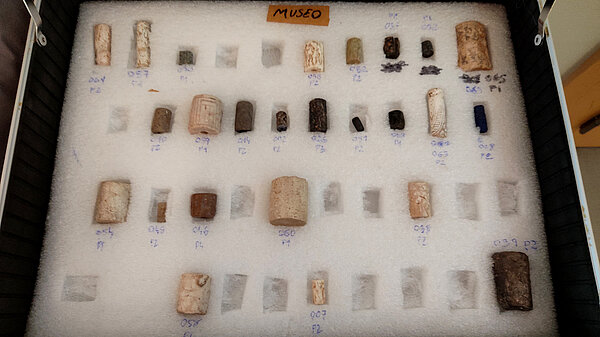
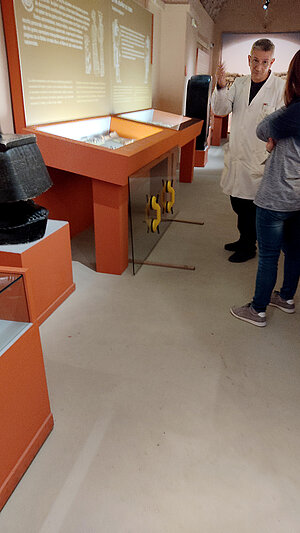
Each of the twenty-four Early Bronze Age physical seals was meticulously scanned with a 3D LED-NIR scanner, measured, and examined under a digital microscope, aiming to extract as much morphological and traceological information as possible. With the help of image-processing software, I was able to carry out extensive observations on the objects, always in a non-invasive manner and taking all the time necessary.
Of course, working directly with the objects provided insights impossible to obtain from printed catalogues alone. Only a small number of seals from the collection had been published previously in Marquez Rowe’s (2015) monograph on the museum’s broader Mesopotamian collection, which includes a wide variety of objects but not extended information for any of them. That was not the aim of this publication, nor was it intended to produce a detailed catalogue of the museum’s collection; therefore, visiting the museum was almost unavoidable if I wanted to know anything useful for my research about the seals.
Direct examination allowed for detailed documentation of previously unpublished seals. Tiny traces on the surfaces, drill holes, and carvings were recorded that could, hypothetically, indicate the hand of a workshop, while specific iconographic choices might reflect particular ways of thinking or imagining the environment in each locality, or the cultural perspectives of distinct human groups.
I also took measurements of certain features of the seals that are often overlooked but hold significant informational potential (Martinez Garcia, 2025). Material traits, such as stone types, drilling techniques, and surface wear, further enrich our understanding of the objects and their makers.
The museum staff facilitated access to archival materials such as inventory cards and old pictures, which provided valuable information about the acquisition history of the seals and enriched the study, but also to their knowledge and know-how, acquired through years of working with the collection. Additional insights on Ubach’s travels and purchases were obtained from his travel diary (Bonaventura Ubach & Roure, 2009).
Why this collection matters
What makes the Montserrat seals genuinely significant is not their size but their singular purchase conditions. The seals preserved a micro-history of acquisition that somehow reflects the movement of antiquities at the time father Bonaventura traveled through Iraq. This alone provided a rare opportunity to form hypotheses about which archaeological sites may have been affected by the antiquities trade and by looting, since many of the sites we know today had not yet been documented or excavated.
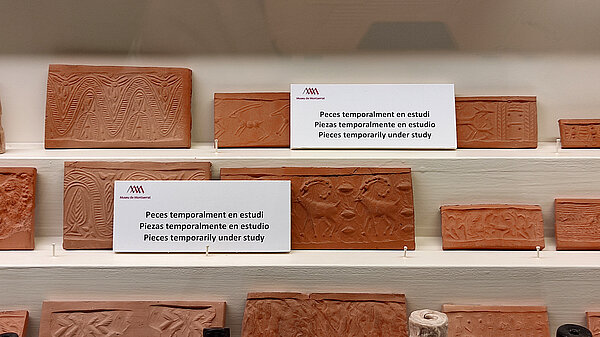
For my doctoral research, the Montserrat seals offered a first controlled experiment in distinguishing urban identities solely through seal imagery and craft traditions. Even with limited numbers, several seals show close parallels to workshops known from southern Mesopotamia. Equally significant is the chronology of the seals, which span almost all major periods of Mesopotamian history. Studied together, they provide a compact yet diverse corpus through which long-term developments in iconography, carving techniques, and material choices can be observed. This makes the collection particularly well suited for methodological experimentation and for testing analytical approaches related to workshop traditions and urban identities, which can add to our knowledge of seals and sealing practices
This is precisely where the KIŠIB project becomes essential. By providing a shared digital infrastructure for seal research, KIŠIB enables collections like Montserrat's to be studied comparatively alongside tens of thousands of other seals. What was once accessible only through a personal visit to a mountain monastery can now be examined, measured, and compared by any researcher with an internet connection.
A promising point of departure
The research stay in Montserrat confirmed that even small collections can offer valuable insights when studied closely. At this stage, the work has allowed for establishing the approximate dating of the seals with greater precision than previously recorded, and as the identification of workshops progresses, increasing parallels are becoming apparent. While I have tentative ideas about the real provenance of a couple of the artifacts, it is still too early to draw firm conclusions. Nevertheless, this study represents a promising starting point for further exploration of unprovenanced seals and their role in understanding urban identities in Early Mesopotamia.
More importantly, with each object added to the KIŠIB database, researchers gain greater access to materials that are otherwise inaccessible, while also making them available to a wider public. I hope that in the not-too-distant future, I will have the opportunity to contribute the rest of the Montserrat collection to the project so everyone can enjoy it.
Bibliography
- Bonaventura Ubach, P., & Roure, D. (2009). Dietari d’un viatge per les regions de l’Iraq (1922—1923) (1. ed). Publicacions de l’Abadia de Montserrat.
- Márquez Rowe, I. (2015). La colección Mesopotámica del Museo de Montserrat (J. Uriach Torelló, Ed.). Museu de Montserrat.
- Martinez Garcia, K. (2025). La Esfragística sumeria en la encrucijada entre errores pasados y posibles revelaciones. Anejos a CuPAUAM., 9, 333-342.




© 2018-2026