Conferences
The KIŠIB project hosts a series of international conferences over its duration, each dedicated to exploring the role of seals and sealings in establishing and maintaining trust on both interpersonal and societal levels in ancient West Asia.
Each conference brings together specialists in ancient Near Eastern studies with colleagues from related fields—including history, social sciences, anthropology, visual culture, and media studies—to examine how sealing practice and seal design conveyed trust between contracting parties across different periods, regions, and institutional contexts. The conferences alternate between Munich and Berlin and produce peer-reviewed open-access proceedings.
First KIŠIB Conference 2026
Why sealing? From sealed clay to social interaction in ancient West Asia
22–24 July 2026 at the Bavarian Academy of Sciences and Humanities Munich and online
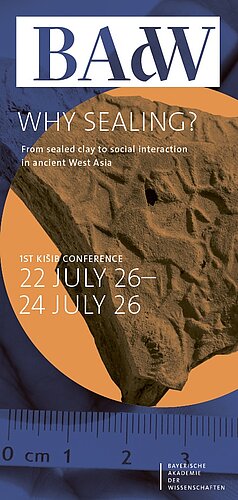
The first KIŠIB conference was inspired by Edith Porada’s 1993 essay ‘Why cylinder seals?’. By asking ‘Why sealing?’, we aim, on the one hand, to explore the materiality of sealings and seal impressions, and on the other to examine the actions and social networks in which they were embedded. In doing so, we address the core concerns of the KIŠIB project: sealing on clay as a communication strategy that was effective over millennia for “sealing” interpersonal relationships, establishing claims of ownership, fostering social trust, and defining authority and hierarchy. To better understand the complex interrelationships between artefacts, images, and inscriptions, as well as between people, objects, and actions, we require expertise from diverse perspectives across an interdisciplinary spectrum of participants.
Sealed containers or door fastenings allow us to trace property-related transactions long before the first written records in Mesopotamia. The use of cuneiform writing from the late 4th millennium onwards did not replace the practice of sealing, but rather opened up additional possibilities for documenting interpersonal and institutional relationships, transactions involving goods and property, and authoritative decisions in detail. The material remains of these ubiquitous practices, in the form of sealings and sealed tablets, offer enormously rich yet difficult-to-decipher insights into the thinking and actions of the time. Relationships and messages could be inscribed and encoded in text, image or artefact features.
A comprehensive evaluation therefore requires a combined analysis on multiple levels: materiality (what was sealed, and how was it sealed?), spatial context (in what physical environment did the sealing and opening of sealed artefacts take place?), personal attribution (which persons or groups sealed?), the social or bureaucratic dimension (did the sealing individual act on their own behalf or on behalf of an institution, and which processes needed to be legitimised?), and last but not least, the seal image (what was the meaning of the image programme employed, and which pictorial semiotic systems were used?).
At this conference, experts working in archaeology and philology will explore these questions – using, amongst other things, digital indexing and analysis strategies. In this way, the ancient people, norms, and actions behind sealed artefacts, seal images, and inscriptions will be brought to light, helping forge stronger links between past and present societies.
We look forward to a lively exchange and discussion not only among the speakers but also with the audience, and we warmly invite you to either attend in person or participate virtually.
Flyer and programme
The flyer for our conference can be downloaded here.
The programme, including all speakers, abstracts and the list of posters, can be downloaded here.
Venue
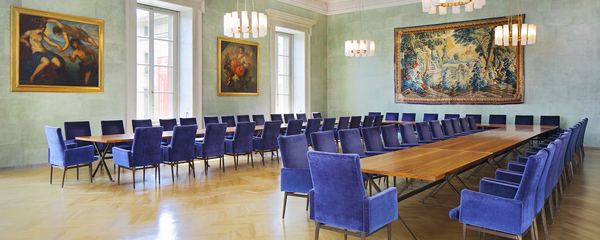
Bayerische Akademie der Wissenschaften, Alfons-Goppel-Straße 11, 80539 Munich, Germany.
How to join?
We warmly invite you to attend the conference, which is designed to facilitate an exchange of ideas and allows ample time for discussion.
The conference will be held in person and also streamed online via Zoom. If you want to participate, please register with Dr Albert Dietz, stating whether your participation will be in person or online: Albert.Dietz(at)kishib.badw.de.
A link will be sent to all registered participants a few days before the conference.




© 2018-2026