People behind seals
Seals and sealings are more than miniature artworks or administrative tools: they encapsulate the person who owned them and were deeply embedded in the social practices of ancient West Asia. Every seal impression not only secured a tablet, a door, or a vessel, but also marked the presence of an individual within a network of relationships. Through their use, seals created visibility for people, offices, and institutions that would otherwise remain invisible in the archaeological record.
Social practice
The act of sealing was never merely mechanical. When a cylinder seal was rolled across a soft clay surface, it produced a visible and durable trace of personal presence and accountability, often during property-related transactions and in hierarchical settings. Sealing was essential for effective contracts, secure storage rooms, and authenticated correspondence, embedding human action within broader administrative, economic, and, more generally, social and religious frameworks.
Because seals were personalised objects—often carried on the body like jewellery or amulets—their use was also part of an individual’s self-representation. To employ a seal was to perform authority, social status, or family identity in a way that could be seen and recognised by others. Sealing thus reveals the social fabric of daily life: who could issue orders, who handled goods, and who interacted with institutional authorities. By studying these practices, researchers gain insight into the subtle but powerful ways in which social order was created and maintained, displayed and manipulated.
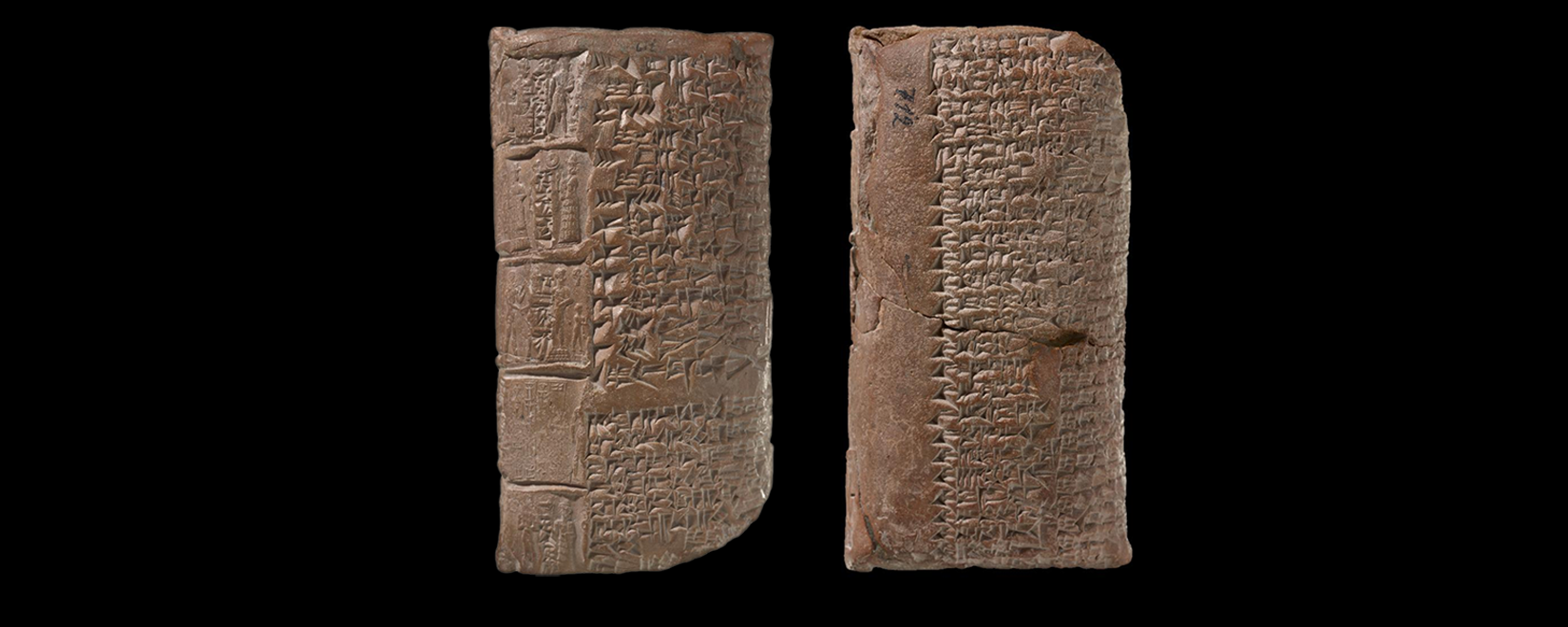
Example: A tablet from Nippur
Date: Ur III period, ca. 2100–2000 BCE (reign of Šulgi, year 36, month 12)
Inscription: “Of Šulgi, valiant hero, king of Ur, is Ur-Dumuzi, the judge, his servant.”
Image: Encounter between a seated king and a man who is led by a female deity.
Source: CBS5136 – The Penn Museum Online Collection
Credit: Penn Museum, unrestricted use for educational purposes.
The inscription on the cylinder seal impressed on this cuneiform tablet from the ancient city of Nippur identifies the seal owner as Ur-Dumuzi, a judge who served under king Šulgi of Ur. But a name is not yet a person. The same name might appear dozens of times across the cuneiform record, referring to different individuals. To move from a textual reference to a historical person, researchers rely on a combination of distinguishing attributes, such as title, profession, family, institutional or hierarchical affiliation (patronyms, servant of), as well as on chronological or contextual clues. When “Ur-Dumuzi, judge, servant of Šulgi” appears on multiple documents from the same period and region, scholars will treat these attestations as referring to a single individual.
This process of disambiguation transforms scattered names into identifiable agents. Once individuals can be distinguished, their roles and co-occurrences with others—as witnesses, superiors, husbands, or business transaction partners—reveal patterns of interaction. A judge who regularly appears alongside the same scribes, merchants, or temple officials is not an isolated name, but a node within a retrievable social network. KIŠIB facilitates this process by treating persons as entities that can be followed through a variety of sources, enabling researchers to trace how individuals moved through institutions and interacted with others over time.
Access to people
Unlike royal inscriptions or monumental texts, sealings preserve the names, actions, and symbols of people who would otherwise remain invisible. A single impression might point to an official overseeing deliveries, a merchant engaged in long-distance trade, or a family member protecting property. These traces allow researchers to reconstruct roles and responsibilities that are rarely documented elsewhere.
By comparing the occurrence of seals across sites, collections, and time periods, scholars can begin to map the presence of individuals and offices within more expansive social landscapes. Sealings link people to institutions such as palaces, temples, or households, as well as to objects such as tablets, jars, or storerooms with their contents. They can reveal family ties, patterns of professional affiliation, and lines of patronage or dependency. In this sense, the study of seal inscriptions and of seal impressions on written artefacts is a valuable and prime source for reconstructing prosopographies: piecing together the lives of people from scattered references. Through the cumulative evidence of thousands of impressions, we can trace networks of interaction that connect different levels of society, from high officials to ordinary craftspeople. And we can connect written signs with pictorial forms, thereby analysing multimodal forms of communication in local, regional, and interregional contexts.
Exploring ancient networks with KIŠIB
KIŠIB models individuals, offices, and institutions as distinct entities, each with its own identifier. This means that a seal owner is not simply a name in a catalogue entry, but a node that can be connected to other attestations across the corpus—and beyond. By integrating with external resources and collaborating with text-centred cuneiform corpus projects, users will be able to trace a person from a single seal to their broader presence in the sealed artefact and the cuneiform record.
In practice, this enables queries that were previously prohibitively time-consuming to answer: Which officials appear together on documents from both Nippur and Ur? How were seal motifs transmitted within families? Did seals and sealing practices differ between professional groups? Who borrowed their seals to whom? Where does a seal reappear after a gap of decades and through whose intervention? Do seals owned by women differ? And how do divine names relate to seal imagery or seal owners? KIŠIB will provide the filters, visualisations, and export options to systematically pursue such questions. By treating seals and their imagery not as isolated objects or artworks but as intersections of people, events, places, and institutions, the corpus transforms cataloguing into social history.