West Asian seals and sealings
The cuneiform sign 𒈩 functioned as the logogram for the Sumerian kišib and the Akkadian kunukku, meaning “seal”, “sealing”, or “sealed document”. For the people of ancient West Asia, this term encompassed far more than an administrative tool or a finely carved stone object. Seals constituted what the anthropologist Marcel Mauss famously described as a ‘fait social total’—a phenomenon permeating economic, legal, religious, and political spheres of social life. This is particularly true for the people of ancient Iraq, Syria, and neighbouring regions over a period of more than 3,000 years, from the invention of cylinder seals around 3400 BCE to the late first millennium BCE and the end of cuneiform culture.
Seals—small stone cylinders or stamps only a few centimetres in size—and sealed clay objects have survived in their thousands at archaeological sites in present-day Iraq, Syria, Turkey, Iran, Lebanon, and Israel/Palestine. Today, more than 150,000 West Asian stamp and cylinder seals and their impressions are dispersed across museums and collections worldwide. Together, they form the earliest, most numerous, and most continuously attested corpus of images from the region. Their frequent association with written administrative practices often allows for unusually precise social contextualisation.
The ubiquity and fundamental societal functions of West Asian seals offer particularly fertile ground for comparative and interdisciplinary research. The miniature images and inscriptions engraved on seals provide detailed insights into ancient networks of social, political, economic, religious, and artistic interaction. They illuminate processes of cultural transmission, evolving modes of visual communication, and shifting ideologies across millennia.
Stamp and cylinder seals
Seals were first developed in Neolithic communities in what is now Syria and Iraq around 6500 BCE to mark property in communal storage spaces. As social complexity increased and administrative practices expanded, cylinder seals—offering a larger engraved surface—gradually replaced stamp seals. This development reversed in the first millennium BCE, when the spread of Aramaic script on papyrus and wax tablets once again favoured the use of stamp seals.
Cylinder seals are small barrels usually made of stone and pierced longitudinally so that they could be worn on the body. When rolled across a malleable surface such as wet clay, they produce continuous bands of imagery. Stamp seals, by contrast, leave framed impressions. Both types were traded, inherited as heirlooms, occasionally modified by later users, or buried with their owners. Their manufacture and use combined personal and material value with protective and amuletic qualities.
Seals in context
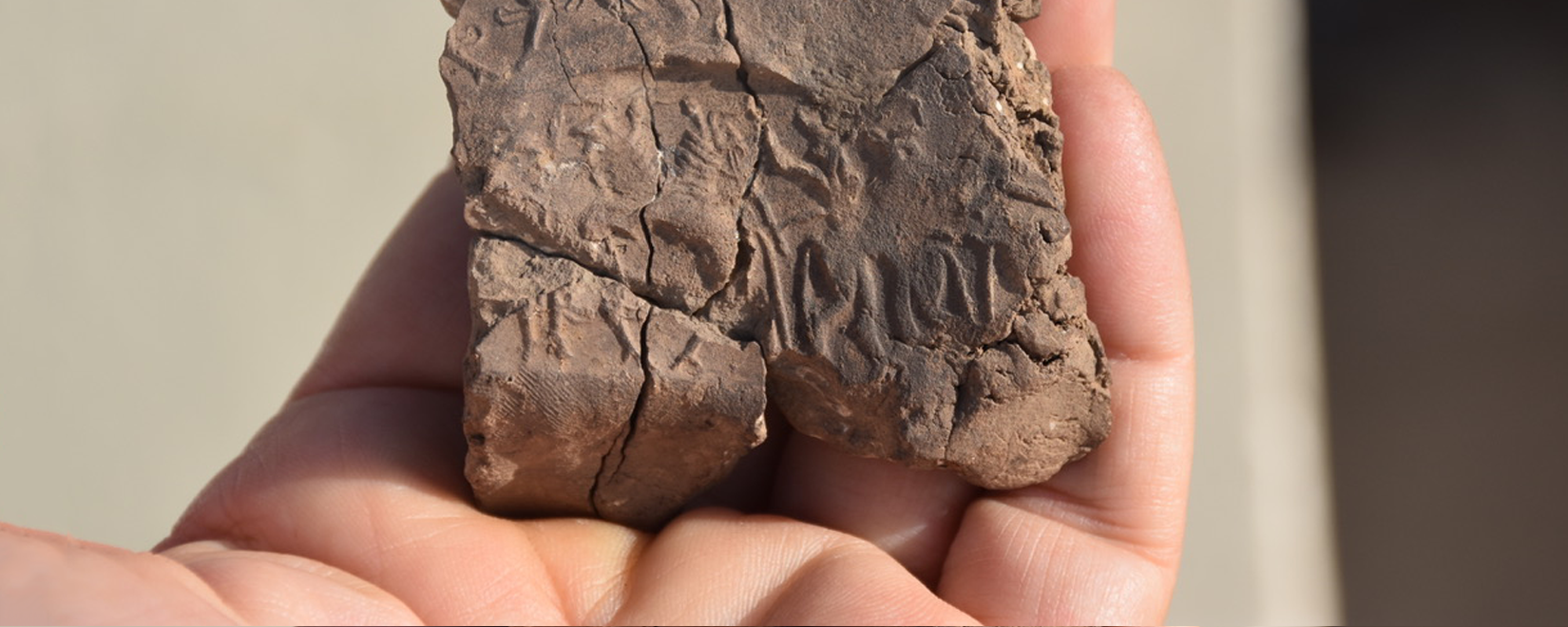
Seals yield particularly rich social and historical information when they can be linked to their contexts of use, such as administrative spaces in private houses, storage facilities, palaces, or temples. Sealed clay lumps attached to doors or containers formed part of everyday administrative practice and are therefore regularly encountered in excavations—provided archaeologists take care to recover these small and fragile remains. In some cases, such sealings were stored together with cuneiform tablets, which themselves could also bear seal impressions.
The combined analysis of seal imagery, style, inscriptions, the form and function of sealed objects, and their associated textual, archival or depositional contexts allows for detailed reconstructions of the individuals and institutions involved in their production and usage. As such, sealing evidence constitutes an invaluable source for studying social interaction, administrative practice, and artistic interconnections in ancient West Asia.
Images and inscriptions
The images engraved on seals encompass a wide range of themes, including encounters between gods and humans, ritual and mythological scenes, warfare and feasting, nature, animals, and hybrid beings. Although each seal was individually carved and owned by a person—or more rarely an institution—the selection and composition of images generally followed established conventions. These often reflect the ideological agendas of ruling elites or other social groups, while the degree of visual innovation varies considerably across periods and regions.
Some seals carried inscriptions. Their frequency differs markedly over time and space. In periods with high rates of inscribed seals, such as the Ur III and Old Babylonian periods (c. 2100–1600 BCE), approximately 50–70% bear inscriptions naming their owners, professions and titles, affiliated institutions and deities. For other periods and regions, inscriptions are rare or absent; yet even in such cases, associated written documents or archaeological assemblages can provide valuable information about ownership and function.
To find out more about ancient West Asian seals, seal impressions and sealing practices, please consult our bibliography. To learn more about the objects catalogued and annotated in the KISIB-project, see our corpus.