Objectives
KIŠIB is a digital research initiative dedicated to the study of seals and sealing practices in ancient West Asia, spanning more than three millennia—from the invention of cylinder seals around 3400 BCE to the late first millennium BCE. Named after the Sumerian word for “seal”, “sealing”, or “sealed document”, the project understands seals as socially and ideologically powerful artefacts that shaped social relations, enabled complex institutional practices, and transmitted cultural knowledge.
At its core, KIŠIB understands sealing as a technology of trust—one that bound persons, institutions, and communities across distance and time (see Explorative framework). Unravelling its working and functions requires a detailed breakdown of the complex pictorial compositions engraved on seals, the structural relations between figures and symbols, and every available bit of information on the socio-cultural background of their production and use.
Tens of thousands of carved stone seals and sealed clay objects survive from across today’s Iraq, Syria, Turkey, Iran and neighbouring countries. Not always, but often closely linked to written administration, they allow for exceptional insights into varied forms of social interaction and visual communication. Yet despite their importance, research on seals remains fragmented, difficult to access, and largely confined to a small circle of specialists.
KIŠIB aims to overcome these limitations by providing open, structured, and well-curated digital access to this dispersed body of evidence. The project brings together more than a century of scholarship with up-to-date digital methods. Its digital infrastructure aims to link information about the seals’ material features, pictorial and textual contents into a coherent whole, accessible through annotated datasets and ready for data-driven approaches in the humanities.
Thereby, KIŠIB aims to bridge disciplinary divides between archaeological, art-historical and philological research and to create a reliable foundation for interdisciplinary exploration. By aggregating multilingual scholarship, by standardising and connecting data on objects, images, texts, and contexts into a knowledge graph, KIŠIB aims to counter the growing risks of decontextualised or AI-generated information.
Beyond academic research, KIŠIB is committed to knowledge exchange and public engagement. The project seeks to democratize access to one of humanity’s oldest visual traditions, support collaboration with scholars and students in West Asia, and provide accessible resources for non-specialists.
To achieve these aims and build upon the experience gathered during two previous projects (2017–2023), KIŠIB rests on four main pillars:
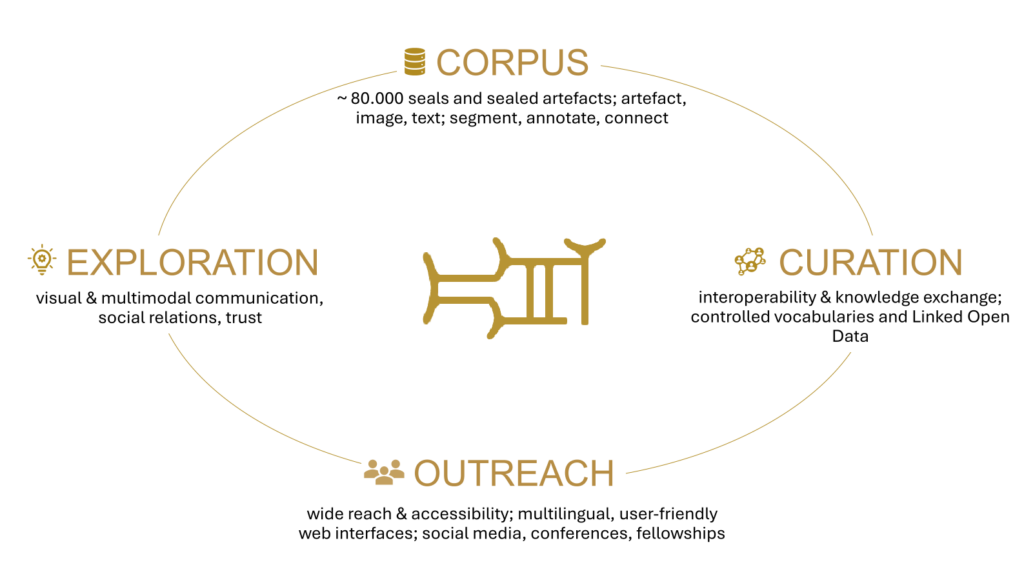
Corpus building
KIŠIB creates a large-scale, annotated digital corpus of approximately 80,000–84,000 seals and seal impressions from ancient West Asia, dating from the 4th to the 1st millennium BCE. This scale is essential for identifying long-term patterns, regional variation, and social dynamics. The corpus integrates information on material properties, imagery, inscriptions, archaeological provenance, and social context, using controlled vocabularies and Linked Open Data standards. It forms the backbone for quantitative, comparative, and machine-assisted research.
Explorative research
The structured corpus enables synthetic and comparative research on a wide range of seal-related features and practices across regions and periods. Building trust—at both interpersonal and societal levels—will serve as the conceptual framing for corpus-driven explorations. Interdisciplinary conferences and publications will connect ancient Near Eastern studies with broader research on multimodal communication and social interaction. A key part of this explorative agenda is the project’s doctoral research programme and international fellowships, which embed individual case studies directly within the KIŠIB corpus and its digital infrastructure.
Knowledge curation
KIŠIB advocates inclusive collaboration between specialised researchers, excavators, and curatorial institutions. It will promote standards and controlled vocabularies with special attention to multilingual scholarship and knowledge exchange with scholars from West Asian countries. Data will be aggregated and curated in accordance with FAIR and CARE principles.
Public engagement
KIŠIB provides open and accessible entry points to the material and visual cultures of ancient West Asia for non-specialist audiences. Through portal pages, multilingual resources, and public outreach activities, the project aims to open windows into the ancient West Asian past, highlight the value of scientific methodologies and critical reasoning, and contribute to a democratisation of knowledge.