Explorative framework
KIŠIB’s digital corpus and granular annotation system will allow everybody to work through and compare the pictorial details of large corpora of images with ease, link them to social network data, and perform powerful Cultural Analytics, a term coined by Lev Manovich to describe computational methods that allow analysis of large data sets of visual material in contemporary and historical contexts. For instance, clustering algorithms can be used to identify groups of seals with similar attributes and co-occurring features; network analysis can contribute to a better understanding and visualisation of the complex relationships between seal design and social actors; and the tracking of motifs will be increasingly automated with the rapid development of AI-assisted similarity search and object detection.
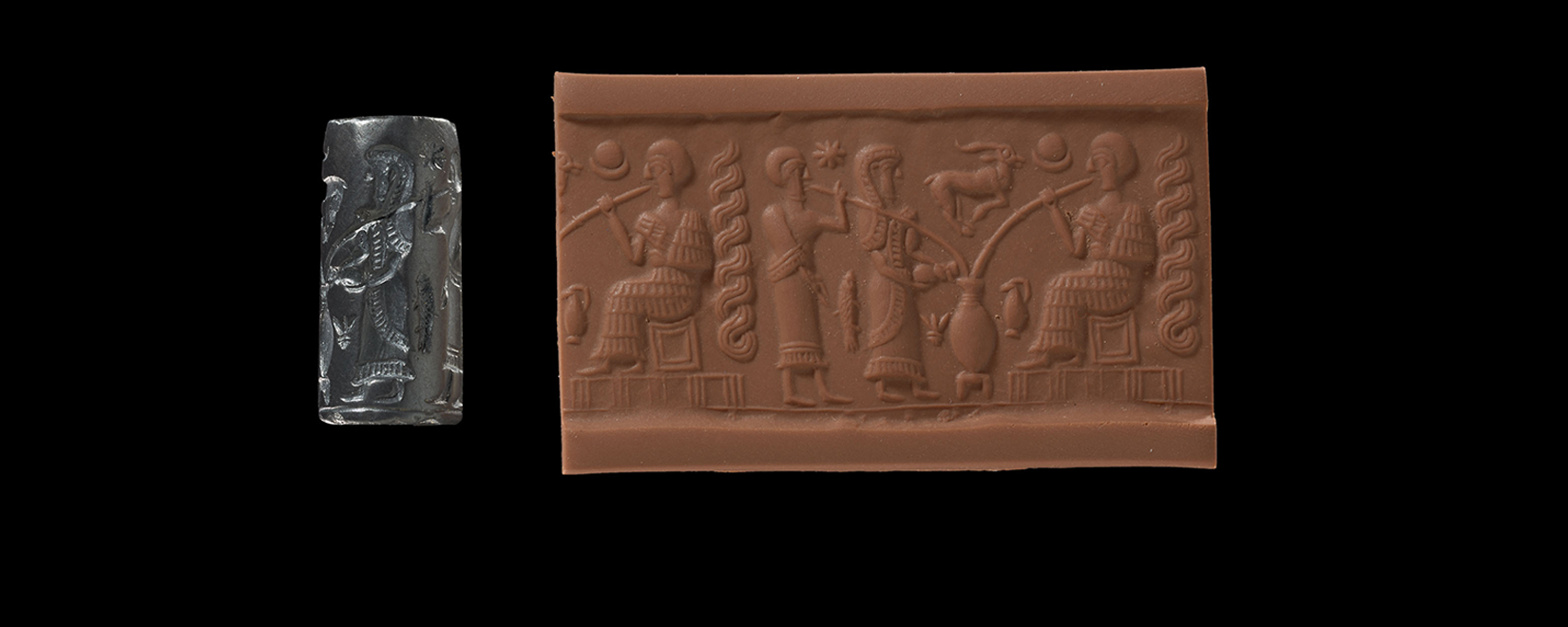
However, there are topics that AI cannot address because semantic fields must be connected. KIŠIB’s explorative framework focuses on a topic we consider crucial for understanding ancient West Asian seals: trust. We propose that the spread and use of personally or collectively owned seals impressed on clay (sealing practice) fostered resilient systems of interpersonal and societal trust. The visual program used in these systems (seal design, including inscriptions) contributed to their success, persistence, and far-reaching impact in economic and political exchange.
There is no doubt that trust forms the basis of reliable social interaction, especially when property-related values, abstract entities or multiple actors are involved, as in the spheres of economy, law, or politics. Ancient West Asian seals were not distributed through a central institution or a universally accepted authority but rather wielded their power through interpersonal relationships. Their visual programs and inscriptions served to associate their owners/users with superior agents, such as gods and kings, unifying events, such as feasting or victorious combat, and shared symbols, such as a winged sun-disc or a rampant lion. Some of these elements became markers of officialdom, others remained expressions of local preferences or even individual choice. The peculiar ways in which sealing practice and visual program most effectively conveyed trust between contracting parties, including the expression of authority and legitimacy, shifted over time, varied across regions, and were shaped by prevailing power structures and belief systems. However, much remains to be done to understand this interplay between artistic forms, material practice, and social relations. KIŠIB considers the concepts of interpersonal and societal trust as an appropriate intellectual framework, and the KIŠIB corpus as an ideal resource and toolkit to guide systematic exploration of these patterns.
This overall framework will be structured into four thematic modules tackling ingroup dynamics (module 1), leadership dynamics (module 2), cross-cultural dynamics (module 3), and material and production dynamics (module 4).
Stay tuned for upcoming conferences, workshops, research and publications, and feel free to reach out if you would like to join us in exploring such topics within the KIŠIB framework!