What we do in the storerooms

This blog post introduces the ancient West Asian seals and sealings of the Museum für Kunst und Gewerbe in Hamburg. While some objects have been published before, large parts of the collection are only now being systematically documented and analysed. Recent work, collaborations, and scientific methods open the way for a comprehensive study and presentation of this material.
The Museum für Kunst und Gewerbe in Hamburg
The Museum für Kunst und Gewerbe in Hamburg (MK&G) was founded in 1874. It houses over 500,000 objects of art, design, and cultural history, from ancient times to the present. This creates a rare opportunity to bring objects from very different periods and backgrounds into a dialogue. The museum is divided into 14 sections, covering everything from ancient civilisations to contemporary design. You’ll find fine craftsmanship, fashion, photography, and even cutting-edge design all under one roof. It often hosts exhibitions, talks, and workshops that connect past and present, sparking fresh ideas about art, design, and everyday culture. No wonder it’s considered one of Europe’s leading museums for art and design.

A real highlight, in my opinion, is the Antiquities Collection. With over 6,000 objects, it is considered one of the most important museums in Germany. Although not known to a broader audience, the museum has a large collection of ancient West Asian stamp and cylinder seals as well as some sealed cuneiform objects. Many of these pieces are still waiting to be discovered. So let me take you on the journey of how we came across this fascinating collection.
How everything started
From the start, this undertaking was always connected to the KIŠIB project. In fact, it was born while working on and writing the application. While we were building the core elements of what the KIŠIB project will stand for, it was clear that we also wanted to document first-hand unknown seal collections. To have reliable data on how many museums and institutions hold seals and sealed objects without a broader scientific audience knowing, I made a survey and contacted hundreds of them in Germany. I was surprised by the large number of collections that had at least a few stamps and cylinder seals, either in their exhibitions or in storage.
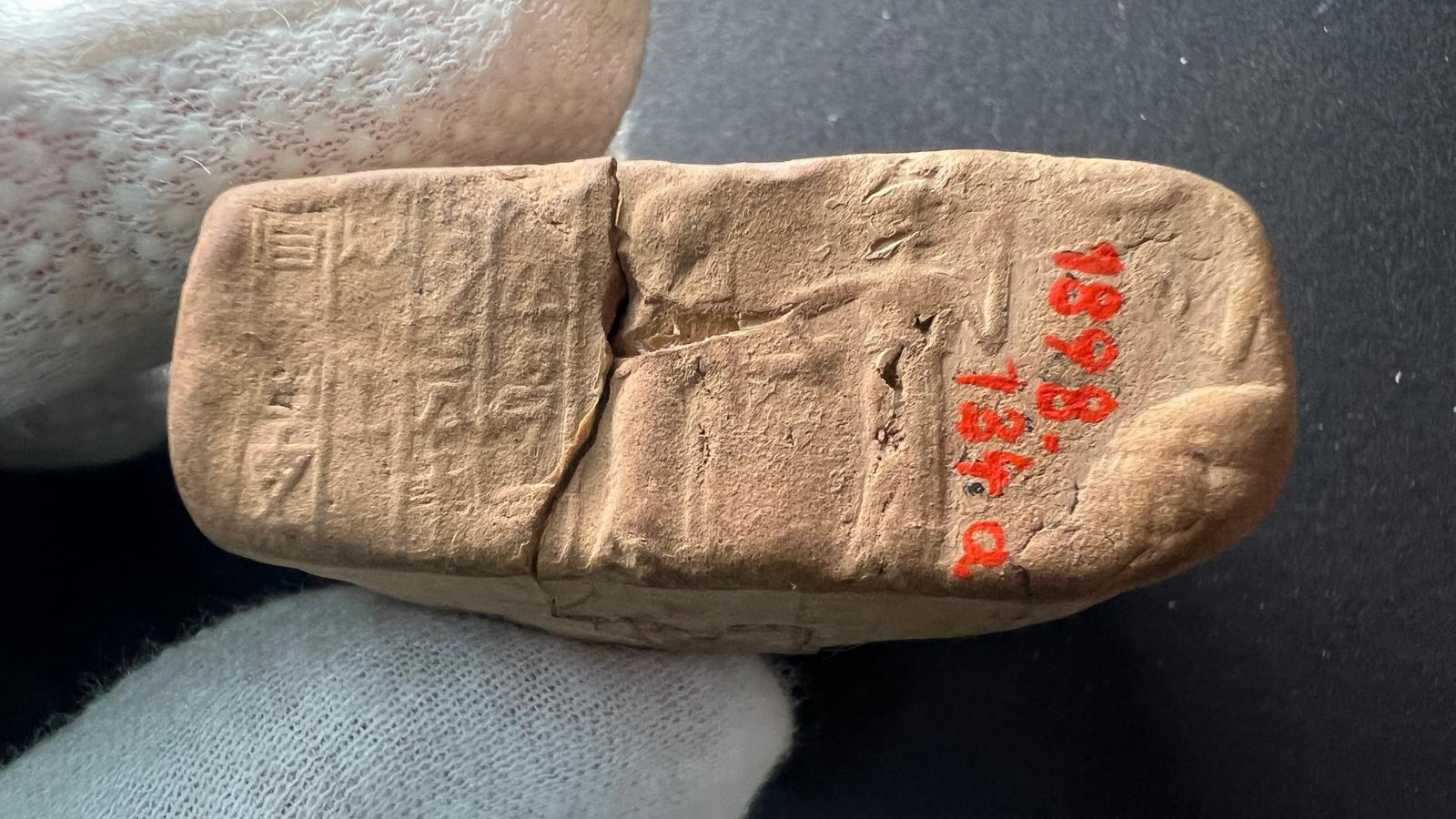
One of these institutions was the Museum für Kunst & Gewerbe in Hamburg. But the Ancient Near Eastern collection of the MK&G is not entirely unknown: the larger half of the cylinder seals (40 pieces), originally from the former private collection of J. Jantzen, was already published by Th. Beran (1968); one of them was re-evaluated prosopographically by Zs. J. Földi (2021). As for the clay tablets and other cuneiform objects, a leg-shaped Middle Assyrian adoption document was published by S. Franke and G. Wilhelm (1985).
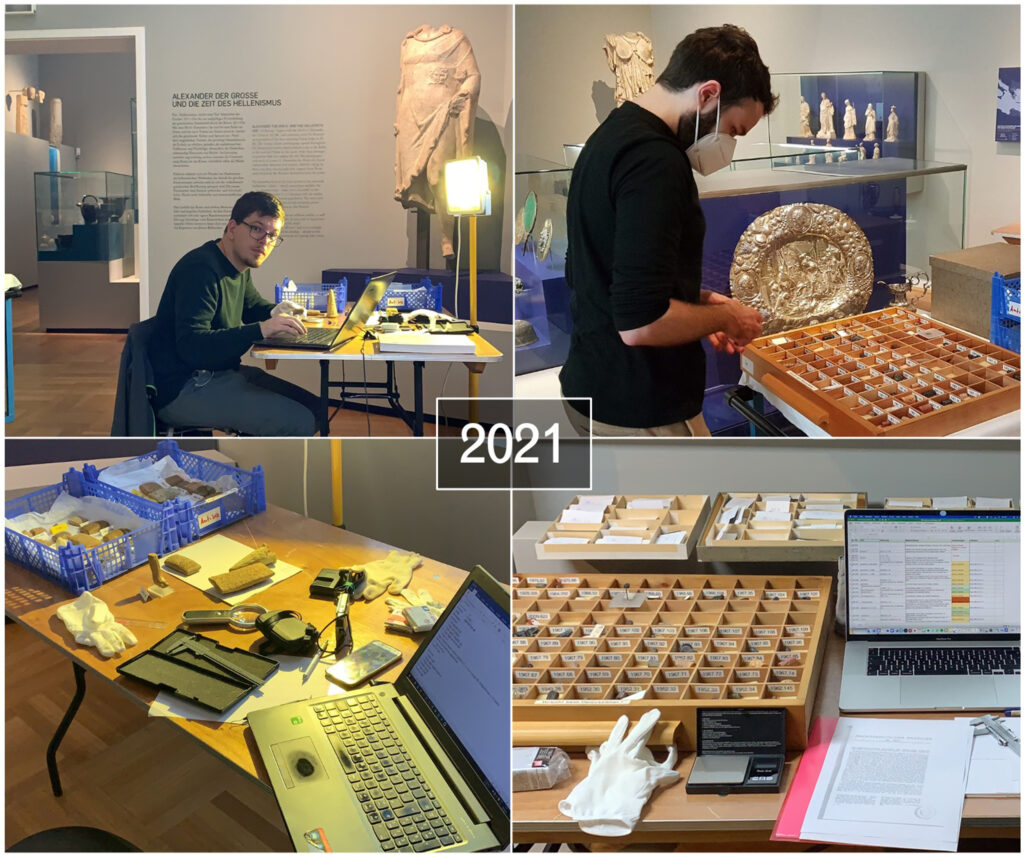
The curator of the Ancient Art and Antiquities collection, Dr. Frank Hildebrandt, was very supportive from the first contact onwards. He encouraged us in 2021 to come to Hamburg and have a look at the seals and tablets. We thought that this opportunity could be a good test case to calculate how much time we need to analyse unpublished material. Together with Dr. Zsombor Földi, a cuneiform specialist who is in charge of the cuneiform tablets and the seal inscriptions, I took the train for a 3-day trip that was filled with exciting impressions (pun intended), never-before-seen seals and new insights on already published material.
Working on the collection
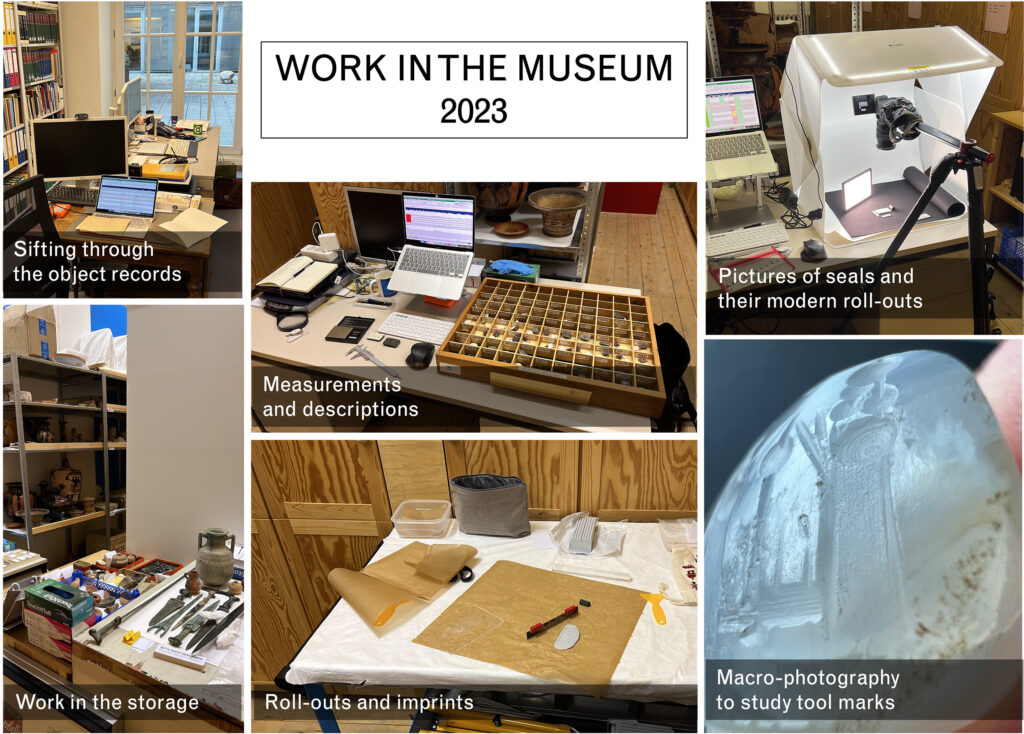
It quickly became clear that the initial three-day survey of the material in August 2021 was too short and that the large number of objects would require detailed study. Thanks to funding from the Deutsche Orient-Gesellschaft, we were able to work at the Museum für Kunst und Gewerbe for two weeks in spring 2023. During this time, we documented, photographed, and examined 62 cylinder seals, 99 stamp seals, and 23 cuneiform objects. The objects range in date from prehistoric times to the Sasanian period. We also gained access to the objects’ inventory cards, which provided valuable information about their acquisition history and enabled us to develop an even deeper understanding of the collection.
The fruitful collaboration with the curator has already yielded further results: the museum staff made 3D recordings of the clay tablets. Scientific methods are also being included in the study of the collection: the stones of the seals are being analysed with Raman spectroscopy by Dr. Stylianos Aspiotis, research associate at the Mineralogical Institute of the University of Hamburg (first results in Aspiotis et al. 2024). This means that identification of seal materials does not have to rely solely on macroscopic observation, but can also draw on scientific evidence. The clay tablets and other inscribed clay objects are the focus of research by Riccardo Cameli Manzo, research associate at the German Electron Synchrotron (DESY) in Hamburg; preliminary results are currently in press.
The ongoing investigations and analyses of the seals and sealings are now being prepared for a comprehensive presentation of the material by Dr. Zsombor Földi and me. All these seals will also be incorporated into the KIŠIB database as part of the ongoing corpus building. The work in Hamburg marks the starting point in the exploration of (partially) unpublished seal collections by the KIŠIB team within the framework of this project. Each year, a new collection will be integrated. Stay tuned for more updates from deep inside the storerooms!
Bibliography:
- Aspiotis, Stylianos – Dietz, Albert – Földi, Zsombor J. – Hildebrandt, Frank – Schlüter, Jochen – Mihailova, Boriana 2024 ‘Material Profiling of Mesopotamian Cylinder Seals by Raman Spectroscopy’, Journal of Raman Spectroscopy 56, 228–242.
- Beran, Thomas 1968 ‘Die altorientalischen Rollsiegel der ehemaligen Sammlung Johannes Jantzen in Museum für Kunst und Gewerbe Hamburg’, Archäologischer Anzeiger 1968, 103–122.
- Földi, Zsombor J. 2021 ‘Princess Ninlil-tukultī, daughter of Šulgi and a cylinder seal in Hamburg’, Nouvelles Assyriologiques Brèves et Utilitaires 2021/65.
- Franke, Sabina – Wilhelm, Gernot 1985 ‘Eine mittelassyrische fiktive Urkunde zur Wahrung des Anspruchs auf ein Findelkind’, Jahrbuch des Museums für Kunst und Gewerbe Hamburg 4, 19–26.
